
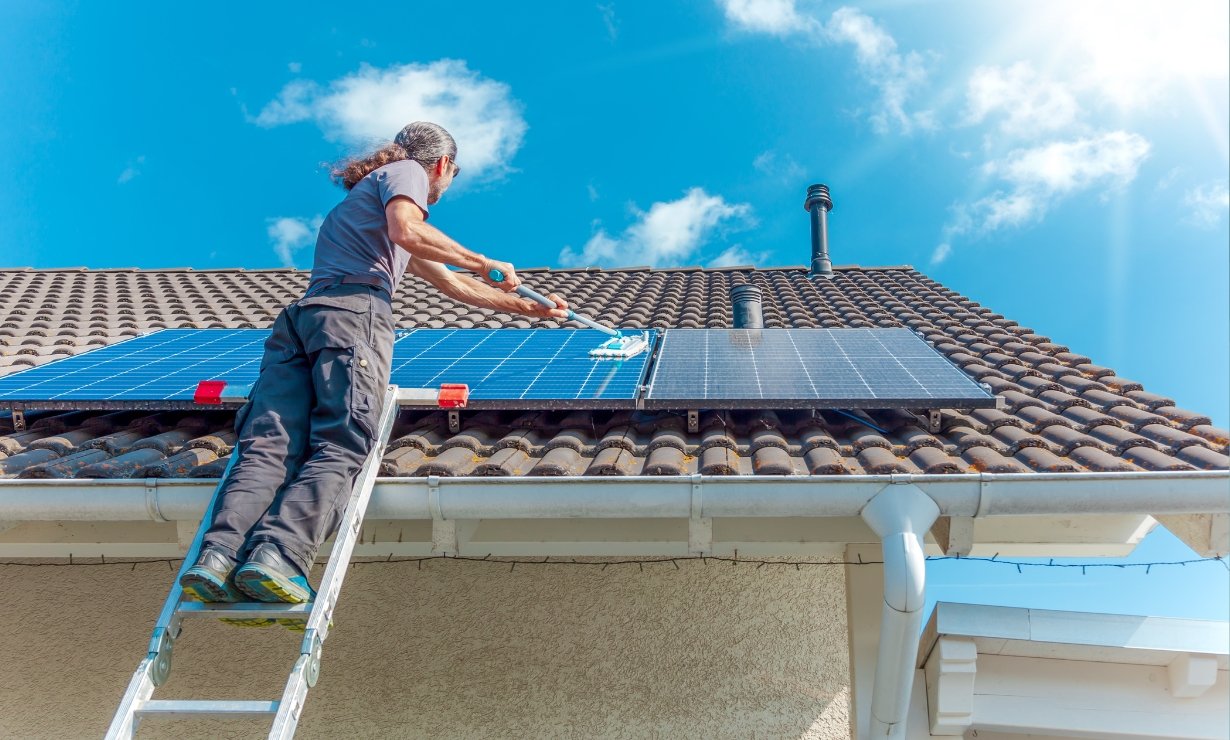
When homeowners first think about solar panel cleaning, the obvious question is: "Can't I just use a hose?" The short answer is no — and the reason comes down to chemistry. The type of water used to clean solar panels fundamentally determines whether the cleaning improves or worsens panel performance over time.
The Problem with Tap Water
Bay Area tap water — like most municipal water in California — contains dissolved minerals including calcium, magnesium, sodium, and silica. These minerals are harmless in drinking water but become a significant problem when applied to solar panel glass.
When tap water evaporates from a panel surface, the water itself disappears — but the minerals stay behind. The result is visible as white or hazy spots, streaks, and deposits on the glass. These mineral deposits:
- Scatter and block incoming sunlight — reducing panel output
- Attract and hold new particulates, accelerating soiling
- Bond progressively more tightly to glass with each application and evaporation cycle
- Are increasingly difficult to remove as they build up over time
- Can eventually etch the anti-reflective coating on high-end panels
Bay Area Municipal Water Hardness (Typical)
| Water Source | Hardness (mg/L CaCO₃) | TDS (Total Dissolved Solids) |
|---|---|---|
| San Francisco (Hetch Hetchy) | 30–60 mg/L (soft) | 60–120 ppm |
| Peninsula / East Bay (EBMUD) | 60–120 mg/L (moderate) | 100–180 ppm |
| South Bay / San Jose | 120–250 mg/L (hard) | 180–350 ppm |
| Deionized Water (DI) | 0 mg/L | 0–5 ppm |
Higher TDS = more mineral deposits per cleaning. South Bay homeowners using tap water face significantly worse mineral spotting than SF residents.
What Deionized Water Does Differently
Deionized water (DI water) has been passed through resin beds that remove essentially all dissolved minerals and ions — leaving water with near-zero total dissolved solids (TDS). When DI water evaporates from a panel surface, there is nothing left behind. Zero deposits. Zero streaks. Zero mineral buildup.
The physical cleaning action is identical — water and a soft brush agitate and rinse away soiling. But DI water leaves the surface genuinely clean at the molecular level, while tap water leaves a new mineral layer with every application.
The Practical Difference
- After DI cleaning: Panel glass is optically clear. Full anti-reflective coating performance is restored. Maximum sunlight transmission.
- After tap water cleaning: Visual improvement but mineral deposits remain. Each subsequent tap water cleaning adds another mineral layer. Over time, panels become progressively hazier even with regular cleaning.
What About Softened Water?
Water softeners remove calcium and magnesium (the primary "hard" minerals) but replace them with sodium ions. Softened water still has significant TDS and leaves sodium deposits on panels. It's better than hard water but not suitable for professional panel cleaning.
Why DIY Cleaning Can Make Things Worse
⚠️ The spotting trap: Homeowners often notice that after cleaning panels with a hose, they look visibly cleaner for a day or two — then appear hazy again. This isn't new soiling. It's the mineral deposits left by the tap water becoming visible as they dry. Each tap water cleaning progressively worsens the underlying mineral buildup.
How We Deliver DI Water On-Site
Clean Panels Bay Area uses a water-fed pole system with an on-board deionization filtration unit. Our filtered water is tested before every job to confirm TDS below 5 ppm — well within professional cleaning standards. We produce DI water on-site and use it exclusively. No tap water contacts your panels during our service.
The Bottom Line on Water Quality
If you're going to clean your solar panels — and you should — use purified deionized water. The difference between DI cleaning and tap water cleaning isn't subtle over time. On South Bay panels with hard municipal water, the mineral buildup from repeated tap water cleaning can reduce transmission by an additional 3–5% beyond soiling alone. For a 10kW system, that's another $150–$250 per year in hidden losses.
Professional cleaning with DI water costs less than the ongoing production loss from tap water cleaning. It's not a luxury — it's the only cleaning approach that actually restores your panels to full performance.